Background
Most construction lumber for homebuilding in Oregon is assessed for suitability for structural purposes following procedures outlined in the US Department of Commerce’s Voluntary Product Standard 20-20, the American Softwood Lumber Standard. The result of following these procedures is typically the application of a grade stamp (also known as a grademark) being applied to the lumber. Oregon building codes require that load-bearing lumber used in structures be grademarked by an accredited lumber grading agency.
Although there are sawmill operations throughout the state, much of the sawing infrastructure has consolidated such that there are areas of the state with few remaining sawmills. There are numerous small enterprises that do not operate at the scale necessary to cover the costs of membership with an accredited lumber grading agency.

In recognition of these circumstances, the Oregon Legislature passed Senate Bill 1061, “the Oregon Forests to Homes Act.” The act establishes a lumber grading training and certificate program applicable to 1- and 2-family residential construction in Oregon. The bill was signed into law by Governor Kotek on July 31, 2025.
The Oregon Lumber Grading program (OLG) described here has been developed by the Oregon State University Forestry & Natural Resources Extension Program in consultation with Oregon’s Department of Consumer and Business Services’ Building Codes Division.
Purpose and Implementation
The Oregon Lumber Grading program is an alternative lumber certification system for Oregon softwood lumber. It is intended to allow, under limited circumstances, structural uses of local-use lumber in home construction where the residential building code would otherwise require grademark lumber. OLG lumber is closely aligned with and expected to have similar performance capabilities as grademark lumber of a corresponding grade and species.
OLG lumber has standards and requirements for certifying the species, grade, moisture content and size of the lumber. These standards generally resemble industry practices, with certain adaptations for applicability to individuals and small- to medium-sized sawmill businesses in Oregon.
This OLG program and accompanying training addresses program authorities and responsibilities, product traceability when the lumber is sold, species allowed for use under the program, standards for nomenclature and measurement of the product, and requirements for additional physical attributes which have implications on structural characteristics of lumber, such as moisture content, surface conditions, and size.
The Oregon State University Extension Service is the administrator of the Oregon Lumber Grading program including providing the certification training, technical assistance and supplemental education.
Scope
This program has a narrow focus on a lumber grading system comprised of 3 substitute grades of dimension lumber and a set of adapted grading rules designed to produce comparable results to their industry counterparts. Dimension lumber in OLG is lumber with a nominal thickness of 2”-4” and a nominal width of 2” and greater, and which is intended for structural uses in residential construction. The program does not apply to beams and timbers as used in heavy timber construction such as timber frame structures.
Species included in the program are: Douglas-fir, western larch, western hemlock, true fir species (white, grand, noble, Pacific silver, and California red fir), lodgepole pine, Engelmann spruce, and Sitka spruce.
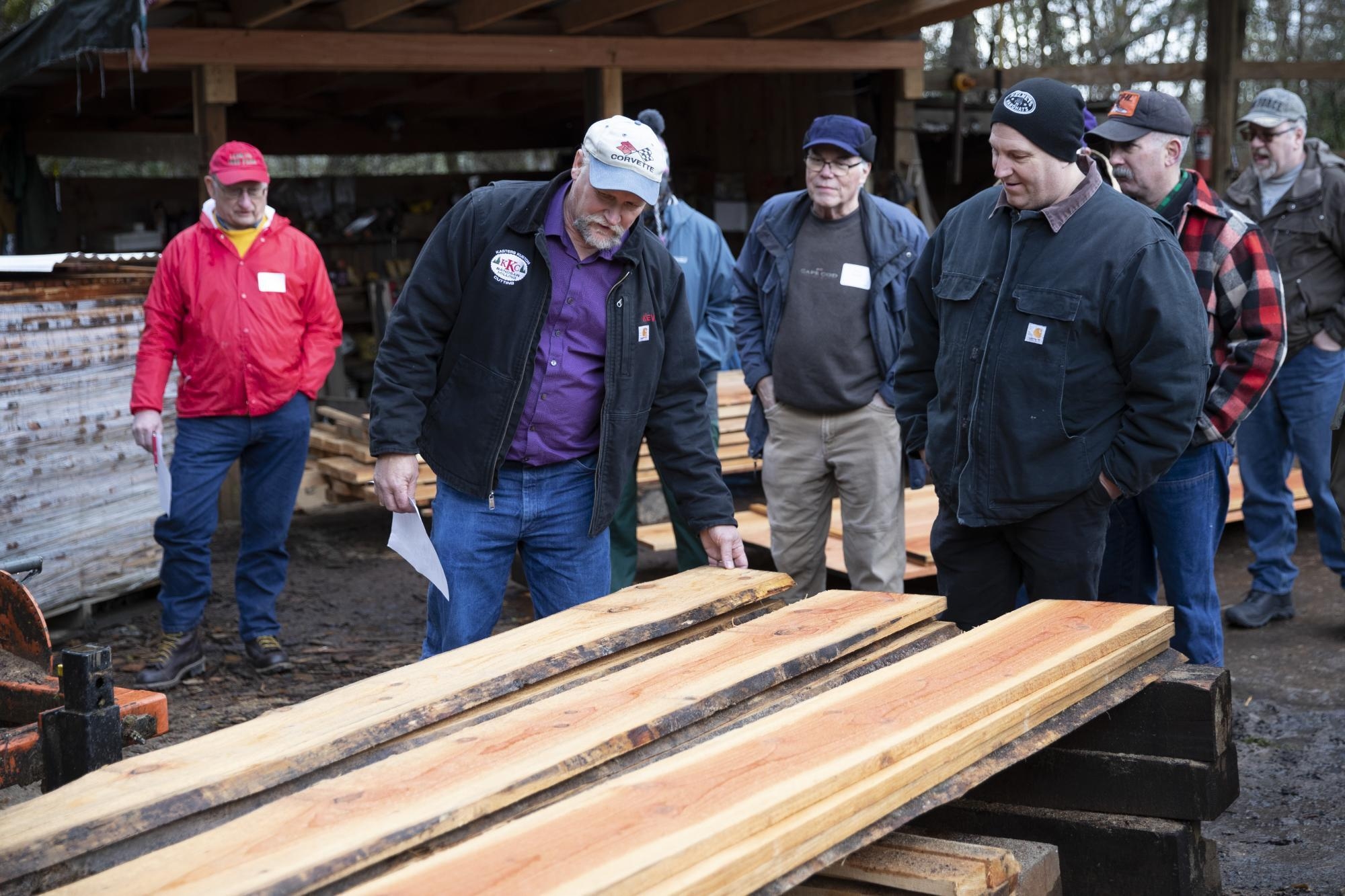
OLG lumber meeting all the necessary conditions which are outlined in the training course and the handbook may be used instead of grade-stamped lumber where required by building codes for residential construction in Oregon.
Certification
Certified individuals may grade dimension lumber that they have sawn or, in the case of larger operations, lumber produced by their business. In either case, the certificate is awarded to the individual who completed the training requirements, not the sawmill business. The owner of a larger operation that has more than one employee (such as a family operation, partnership, or other small company), may grade lumber sawn by an employee of their business. A person may not grade lumber sawn prior to obtaining certification or lumber obtained from any external source.
The completion of the training program does not allow any person to apply the grade stamp of any kind, including those developed by established lumber grading bureaus, nor to make any imprint on lumber resembling an industry grade stamp.
The primary means for a manufacturer to obtain the Oregon Lumber Grading program certificate is to attend the one-day OSU Extension Service training course and successfully complete the proficiency requirements, which include a written test. Participants must be at least 18 years old to be eligible to earn the certificate. Typically, several trainings per year will be offered at locations throughout the state, or as demand warrants. The training program will be offered at a minimum once a year. The certificate is valid for 5 years after the date of issuance and can be renewed by retaking the training and passing the exam. Participants of the program have access to continued technical support and educational resources from the OSU Extension Service.
For more information, see the Oregon Lumber Grading Program Handbook
Form to complete for Written Certification of Dimension Lumber Graded under the Oregon Lumber Grading Program.
Summary table of Oregon Dimension Lumber Grades (click to enlarge).

Next Courses:
The workshops will be 8 am to 5 pm.
October 5th (session 1 - full) and 6th (session 2), 2026, Lagrande - Click here to register. (As of Sep 2, 15 seats are left)
October 8th (session 1 - full) and 9th (session 2), 2026, Roseburg - both sessions full
The course fee is $100.
List of currently certified individuals:
| Name | County | Certificate Number | Date of Training | Expiration Date |
|---|---|---|---|---|
